Posts tonen met het label Recht. Alle posts tonen

donderdag, maart 24, 2016

HOOFDSTUK: "Montesquieu en het volkenrecht" in: Andreas KINNEGING, Paul DE HERT & Maarten COLETTE (eds.), Montesquieu. Enigmatisch observateur [De Debatten], Antwerpen: Vrijdag, 2016, pp. 231-248. ISBN 9460014720


(Bron afbeelding: uitgeverij Vrijdag)

Op 26 april wordt in het centrum De Buren in Brussel een collectief werk voorgesteld over Montesquieu. Diverse essays van specialisten bekijken de Franse magistraat en (rechts)filosoof, van publiekrecht over politiek tot filosofie en emoties.

Abstract:
Montesquieu’s oorspronkelijke denken en schrijven kent dankzij zijn uitzonderlijke stijl nog altijd vele bewonderaars, en roept evenzeer  controverse op. Twaalf auteurs brengen zijn veelzijdige oeuvre opnieuw tot leven, doordenken de onderwerpen die hem tot een geslaagd schrijver maakten, de polemieken die hij veroorzaakte, en de pennen die hij in beweging bracht. De diverse essays verkennen zijn denken vanuit filosofisch, politiek, sociaal, literair en juridisch perspectief.
Pittige essays over cultureel en maatschappelijk relevante onderwerpen, ook al leefde Montesquieu in de 18e eeuw.
Inhoudstafel:
Woord vooraf (Wilfried Rauws, decaan faculteit Recht & Criminologie, VUB)

Deel I Constitutionalisme
Montesquieu en de Verlichting: van tweeën één (Andreas Kinneging, Leiden)
De constitutie van de vrijheid volgens Montesquieu: evenwicht van machten en strafrecht met mate (Jean-Marc Piret, VUB)
De vrijheid in Montesquieu's denken over de constitutie en het strafrecht. Een gepassioneerd liefhebber van de vrijheid ? (Paul De Hert, VUB)
Montesquieu en de uitvinding van de moderne vrijheid (Annelien De Dijn, VU Amsterdam)
Rousseau, dwarse lezer van Montesquieu (Maarten Colette, VUB)
Montesquieu en marginale toetsing in het bestuursrecht (Lukas van den Berge, Utrecht)

Deel II Eros en Thanatos
De erotische kern van Montesquieu’s liberalisme: opgaven voor moderne samenlevingen (Ringo Ossewaarde, Twente)
Beschouwingen van een verontrust moralist. Over de Lettres persanes (Alexander Roose, UGent)
Dood en zelfdoding in de Lettres persanes (Paul Pelckmans, UA)

Deel III  Internationale betrekkingen en klimaat
Montesquieu en het volkenrecht (Frederik Dhondt, VUB/UGent-FWO)
‘Een Rus moet worden gevild om hem iets te laten voelen’. Over Montesquieu’s klimaattheorie (Patrick Stouthuysen, VUB)
Montesquieu en Italië (Michel Huysseune, VUB)
Chronologie 1689-1755 (Maarten Colette, VUB)

Noten

Bibliografie

Over de auteurs

Dankbetuiging
Het boek kan aan € 29,95 worden voorafbesteld op Bol.com, of op de avond zelf worden aangeschaft. Zie ook Google Books.


 Meer informatie op de event-pagina, of bij uitgeverij Vrijdag.

Update 6 March 2019: this book has been accepted for inclusion in the VABB database.

vrijdag, november 28, 2014

"Catalonia, the European State System and International Limits to Self-Determination" (BelConLawBlog)

The Belgian Constitutional Law Blog (an initiative of the Public Law-department at Ghent University) published some historical reflections by your most humble servant on the relationship between Catalonia and Spain. Click here.

vrijdag, februari 21, 2014

Samenvattingen doctoraat (NjW/Handelingen Geschiedkundige Kring Oudenaarde)

http://search.ugent.be/meercat/x/view/ser01/000010506

http://www.kluwer.be/njw

Twee Nederlandstalige signaleringen van mijn doctoraatsverhandeling verschenen onlangs:
- Bijdrage "Machtsevenwicht en internationaal recht", Nieuw juridisch Weekblad nr. 296 (12 februari 2014), p. 142
- Samenvatting (10 p.) in Handelingen van de Geschied- en Oudheidkundige Kring van Oudenaarde, van zijn Kastelnij en van den Lande tusschen Maercke en Ronne vol. LI (2013), pp. 301-310

donderdag, januari 30, 2014

ARTICLE: "Jülich and Berg between Imperial and Public International Law" (Beiträge zur Rechtsgeschichte Österreichs: recht [durch] setzen: Making Things Legal. Gesetzgebung und prozessuale Wirklichkeit in den europäischen Rechtstraditionen, Hrsg. von K. STAUDIGL-CHIECHOWICZ, Ph. KLAUSBERGER, R. PILS, P. SCHEIBELREITER & C. SCHMETTERER. III (2013), Nr. 2 [Acta of the 2012 European Forum of Young Legal Historians], pp. 355-362. (ISSN 2221-8890)


The Austrian Academy of Sciences just published the Acta of the 2012 European Forum of Young Legal Historians (Vienna) as the second issue of the Beiträge zur Rechtsgeschichte Österreichs third volume (2013/2). Among many 34 papers, one of mine (pp. 355-362), containing some reflections on the legal interpretative framework concerning the famous Jülich/Berg question, a dispute opposing the Electors of Brandenburg, Saxony and the Palatinate. In this text, a shorter version of my intervention in 2012, I argue that an outsider-approach on issues within the Holy Roman Empire has not only political consequences, but also impacts the legal terms in which the dispute is framed.

Abstract:
Charles VI. famously promised Prussian King Frederick William I. the succession of the duchies of Jülich and Berg in 1726, but did not keep this treaty pledge. Frederick II. did not think high of public international law, but used this as a political motive for revenge on Austria in November 1740, starting the War of the Austrian Succession. Although the Emperor benefitted from an advantageous position in Imperial law, which was essentially feudal for successions, his decisions in the 1720s were always the counterpart of a bilaterally negotiated concession by the other party, triggered by European, rather than German politics. In the light of the Utrecht and Italian examples, it can be argued that the power relations at the inter-sovereign level and the resulting political compromise created an implicit hierarchy, where vertical Imperial law was bowed and bent to fit the main players’ horizontal options.

maandag, juni 10, 2013

Rechtshistorische Courant, juni 2013

(afbeelding: rechtsgeschiedenis.be)

Nu het doctoraatsstof wat is nedergedwarreld en mijn verhandeling op het decanaat berust in afwachting van een deskundig juryoordeel dat al dan niet tot een verdediging lijdt, signaleer ik graag nog eens de Rechtshistorische Courant, wiens edities onverdroten zijn blijven verschijnen tijdens het schrijfproces. De brief voor de maand juni vindt u hier.

woensdag, mei 22, 2013

19th European Forum of Young Legal Historians


DSCN1761
Originally uploaded by Frederik Dhondt
Last week, the legal historians from Ghent University and its French partner Lille-2 (CHJ) jointly organised the 19th European Forum of Young Legal Historians.

This annual conference started in Germany, but travelled every year on the continent (2007: Seville; 2008: Pécs; 2009: Firenze; 2010: Frankfurt; 2011: Maastricht; 2012: Vienna; 2013: Ghent/Lille; 2014: Cambridge). The Forum serves as a low-threshold opportunity for Ph.D.-candidates to present their work in their own, or another language, to a European audience. Personal bonds are easily constructed during four days of conference. Organising one of the editions implies winning an election at the Association of Young Legal Historian's general assembly, and thus active networking.

Over 60 papers were presented, clustered around the central theme of "(Wo)Men and the Law". The latter should not be seen as a rigidly applied paradigm of discourse analysis. Instead, almost all presenters seized the opportunity to approach their research object from a gendered perspective, with all the due caution applicable to their respective historical cases.

The keynote lecture, given by prof. Alain Wijffels, showed how a 1605 pamphlet against Henry III (King of France, 1574-1589), L'Isle des hermaphrodites (fulltext on Gallica), was framed in gendered terms. The King's predilection for male "mignons" was used to create a hermaphorite utopia. Inverting the normal gender structure of society implied inverting all moral order in society. The satirical work listed a catalogue of ficticious legal norms and values, portraying inter alia a blindfoldless (and thus corruptable) Themis.

Traditionally, professors are expelled from the conference on the first full day, as Ph.D.-students and young post-docs take the floor. Inevitably, the focus on gender representations took many presentations to foray into the context of legal norms, rather than on formal sources of the law. My own intervention on Elisabeth Farnese ("Bring this mad woman to reason!"), dominant queen of Spain (1714-1746) was built on impressions in diplomatic correspondence, and thus on subjective impressions that are only relevant at a meta-level, in the sense that they can have legal norms as a conversationial object. In the ferocious Queen of Spain's case, he fact that a woman could use the legal means normally at her husband's disposal, was seen as a transgression. Elisabeth made an impossible hodgepodge of legal argumentation herself, relying on treaties she failed to comply with, or putting forward succession claims contrary to imperial law. In the end, however, she managed to maintain the status of her own house, the Farnese, by installing her Bourbon-Farnese offspring as sovereign rulers in Italy.

Pictures of this years' conference can be found on flickr.

dinsdag, maart 05, 2013

Rechtshistorische courant, maart 2013

De collega's Debaenst, Vandenbogaerde en Vankeersbilck werkten een nieuwe Rechtshistorische Courant af. Blikvanger is zonder meer het droevige nieuws van het overlijden van prof. em. dr. h.c. mult. Robert Feenstra (Leiden), een monument van de rechtsgeschiedenis in Nederland en ver daarbuiten.

Meer informatie op de site van het Instituut voor Rechtsgeschiedenis.

vrijdag, februari 22, 2013

XIXth European Forum of Young Legal Historians (15-18 May 2013, Ghent/Lille): statistics

According to an established tradition, I made some statistics out of the upcoming European Forum for Young Legal Historian's programme:

1. Gender (well, if the conference turns around "(Wo)Men in legal history"...)
  • Men: 29 (43,94%)
  • Women: 37 (56,06%)
 2. Nationality
- Benelux: 15 (=22,73%)
  • Dutch: 8
  • Belgian: 7
- Eastern Europe: 13 (= 19,69%)
  • Poland: 8
  • Hungary: 3
  • Romania: 2
 - France: 7 (= 10,61%)
- German-speaking world: 7 (10,61%)
  • Austria: 4
  • Germany: 2 
  • Switzerland: 1
- North-Eastern Europe and Scandinavia: 6 (9,09%)
  • Estonia: 3
  • Norway: 1
  • Lithuania: 1
  • Finland: 1
- Italy: 6 (9,09%)

- South-Eastern Europe: 5 (7,58%)
  • Croatia: 4
  • Serbia: 1
- Iberian peninsula and Latin America: 4 (6,06%)
  • Spain: 1
  • Brazil: 3
- British Isles: 3 (4,55%)
  • United Kingdom: 2
  • Ireland: 1 
Programme and registration form are available. See ESCLH blog.

dinsdag, februari 19, 2013

Zweitstimmen en Überhangmandate

Voor wie in eenvoudige termen iets wil begrijpen van het Duitse kiessysteem (dat evenredige vertegenwoordiging op Land-niveau combineert met een meerderheidsstelsel in individuele kiesdistricten), is er een mooi artikel in het Frans verschenen bij Jus@Politicum (online tijdschrift voor politiek recht), van de hand van Alexis Fourmont. Tekst staat hier.


woensdag, januari 30, 2013

BOOK: European Traditions: Integration or Disintegration ?, ed. J. Oosterhuis & E.D.G. Van Dongen (Nijmegen: Wolf Legal Publishers, 2013, ISBN ISBN 9789058509444)


The Acta of the 17th European Forum of Young Legal Historians, held in Maastricht in April 2011, are out. Janwillem Oosterhuis and Emmanuel Van Dongen compiled contributions from Tomislav Karlovic, Henrik-Riko Held, Dave De ruysscher, Valerio Massimo Minale, Paulina Swiecicka, Augustin Parise, Merike Ristekivi, Stefan Weishaar, Tamas Notari, Paulo Potiara de Alcantara Veloso, Frederik Dhondt, Raymond Kubben, Christoph Schmetterer, Diego Nunes, Laszlo Komaromi and Gabor Batho.

Abstract:
"European legal traditions can be characterised as a continuous balancing act of two seemingly contradictory forces: centralisation and de-centralisation. On the one hand, Justinian’s Corpus iuris, the medieval ius commune of Roman and Canon law, the usus modernus pandectarum, and the current European harmonisation efforts all have a centralizing  or  rather  an  integrative  quality  about  them.  While the ius proprium, including the English Common law, and particularly the national codifications of the 19th century, as well as the study of these laws, exhibit more diverse, decentralizing forces within European legal traditions.
This  volume  shows  how  comparative  legal  history  can be  used  as  a  tool  to  analyse  similarities  and  differences between legal systems. It aims to provide a deeper understanding of common strands in law shared by European countries,  in  particular  those  (i)  at  a  substantive  level, through shared legal ideas and principles such as clausula rebus sic stantibus, unjustified enrichment, cessio bonorum,  subsidiarity  or  popular  sovereignty;  (ii)  at  a  formal level, through a common legal language; and created (iii) by scholarly networks and (iv) appellate courts.
Above all, these contributions – though eclectic in their subject matter, time period and methodology – all reflect from a historical perspective on the fascinating, diverse European legal traditions."
Abstract for my article:
Early modern European international relations (1450-1815) appear in contemporary manuals as a ceaseless succession of bloodshed and competing sovereign claims. Likewise, the development of international law is assumed to have known a qualitative boost at the end of the nineteenth century, when law turns into a ‘gentle civilizer of nations’ (Koskenniemi). Law disciplines the sovereign state by imposing order through universal principles, applicable to other entities (individuals/international organizations) as well. However, both narratives are inconsistent with international law’s prime objective: international order, which can also be achieved through legal arguments in a non-institutionalized and tempered anarchical environment. This is the case during ‘les trente heureuses’(Le Roy Ladurie), the period running from the War of the Spanish Succession (1702-1714) to the War of the Austrian Succession (1740-1748). With the break-up of medieval conceptual European unity at the Westphalia Treaties (1648), a new discourse accom-modating all partners had to be found. It took the ‘Société des Princes’ (Bély) until the 1713 Peace of Utrecht to develop a horizontal, instead of a vertical consensus. The political impracticability of the latter structure had been proven, since it supposed a sufficiently strong and buttressing hegemony, which neither the Emperor, nor the Spanish or French King could incarnate. Consequently, Imperial (leaning on Roman and Imperial feudal law), Spanish (based on Castilian public Law) and French (rooted in unwritten domestic fundamental laws) discourse was unacceptable as a common vector. Within the practical community of early eighteenth-century diplomats, horizontal discourse, or the conceptual language of treaty law, became predominant (Lesaffer). An eminent example of this were the successions of extinguished sovereign houses (Steiger). As one of the most fundamental political issues, the designation of the prince’s successor was determined by internal constitutionalized norms. However, this proved to be a political fiction, because of the combination of the European state system’s interdependence and power inequalities. Succession laws and even domestic private law were used by big powers as a pretext to invade whenever they felt pleased to (War of Devolution/Nine Years War). Internationally unregulated successions stimulated instinctive instability and were thus a liability to European order. Through the process of negotiation of the so-called partition treaties on the Spanish Succession (1668-1700 – Bérenger/Rule), an early consensus on this last point materialized amongst the big powers France, Britain-Holland and the Empire. The War of the Spanish Succession sealed the fate of pan-European war, the alternative to regulation (Dhondt). In this conference paper, I present how the ‘peace system’(Chaussinand-Nogaret) of abbot Dubois (1656-1723) and Earl Stanhope (1673-1721) dealt with succession questions in the post-Utrecht period, and how this practice evolved during the 1720’s and 1730’s, under Prime Ministers Cardinal Fleury (1653-1743) and Robert Walpole (1676-1745)(Vaucher/Black). Generally speaking, a Franco-British tandem acted as the motor of European affairs, mounting multilateral interventions against transgressors such as Spanish King Philip V in his 1717-1718 invasion of Italy, pushing bilateral issues up to a higher level of resolution, the political agora of European-wide congresses. These congresses, held at Cambrai (1722/1724-1725) and Soissons (1728-1729) have left ample dispatches by the pleni-potentiaries, in which the above cited rhetorical and conceptual oppositions come into light. It reinterpret the latter primary sources (State Papers, Kew – Archives Diplomatiques, Paris), which I currently examine in my doctoral dissertation, through the rich explanatory grid of international law.

The book counts 256 pages and can be ordered with Wolf Legal Publishers for € 24,95.

A flyer can be found here.

maandag, september 10, 2012

Rechtshistorische courant, sept. 2012 (NL/FR versie)


 Zoals elke maand brengt het Gentse Instituut voor Rechtsgeschiedenis de "Courant" uit. U vindt de twee versies online:
  • Nederlandstalig: op de site van ons instituut
  • Franstalig: op de rechtshistorische blog Nomôdos

maandag, juli 16, 2012

Rechtsgeschiedenis op podcast

Een nieuwe interessante Memo-uitzending: een lang onderhoud (uitgesponnen over 3 uitzendingen) met Régine Beauthier, die aan de ULB rechtsgeschiedenis doceert. Thema: Droit et genèse de l'État, naar haar gelijknamige handboek. Klik hier voor de podcast.

vrijdag, februari 03, 2012

Nieuwsflash - Update Rechtshistorische Courant februari 2012

Update van de Courant voor februari 2012: toevoeging van een lezing over rechtsiconografie van prof. G. Martyn aan de Université Lille-II, volgende week.

donderdag, februari 02, 2012

Rechtshistorische Courant februari 2012


Vandaag verschijnt de februari-editie van de Rechtshistorische Courant, de elektronische nieuwsbrief die het Gentse Instituut voor Rechtsgeschiedenis al sinds 2006 de wereld in stuurt. Geïnteresseerden in het laatste nieuws over publicaties, calls for papers of jobs in het rechtshistorische veld, kunnen op eenvoudig verzoek abonnee worden door te mailen.

Voorgaande nummers staan online op rechtsgeschiedenis.be.

vrijdag, september 30, 2011

"Zentral im Lehnswesen nach Ganshof: das flämische Lehnsrecht, ca. 1000-1305" (D. Heirbaut)


Andere recent verschenen rechtshistorische publicatie: mijn promotor publiceerde een overzichtsartikel over het Vlaamse leenrecht (waarvoor hij een van de grote specialisten is) in het gerenommeerde Duitse Zeitschrift der Savigny-Stiftung für Rechtsgeschichte (Germanistische Abteilung), onder de titel "Zentral im Lehnswesen nach Ganshof: das flämische Lehnsrecht, ca. 1000-1305" (Band 128, pp. 300-347). Wie een up-to-date en wetenschappelijke synthese zoekt van het Vlaamse leenrecht, weet dus voortaan waar kijken.

TIJDSCHRIFT: Pro Memorie. Bijdragen tot de Rechtsgeschiedenis der Nederlanden XIII (2011/1) (ISSN 1566-7146)


(afbeelding: Verloren)

In de recentste aflevering van het tijdschrift Pro Memorie verscheen een uitgebreidere versie van prof. Wijffels' (UCL/Leiden/CNRS Dijon) inleiding op de recentste Rencontres d'histoire du droit de la Fondation Biermans-Lapôtre (afgelopen mei), onder de titel "Justitie en behoorlijk bestuur: Hans Vredeman de Vries' schilderijen in het stadhuis van Danzig (Gdánsk)" (pp. 103-118). Alweer een reden om een abonnement te nemen op dit Belgisch-Nederlandse tijdschrift (zie ook een kleine recensie van uw dienaar, waarin de lijvige Ripperda-biografie van Sytze van der Veen vanuit rechtshistorisch oogpunt wordt bekeken).

Update: het nummer kan in open access gelezen worden op de website van AUP.

Nieuwe website Rechtsgeschiedenis.be


Collega Sebastiaan Vandenbogaerde heeft de site www.rechtsgeschiedenis.be, de webstek van het Gentse Instituut, in een nieuw kleedje gestoken. Voor alles wat u altijd al had willen weten over rechtshistorische couranten of causerieën, of over het menselijke raderwerk van deze wetenschappelijke machine.

dinsdag, juli 26, 2011

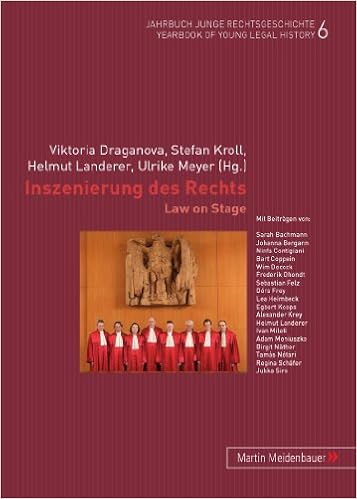
BOOK: Yearbook of Young Legal History 2010

(image source: amazon.de)

Inszenierung des Rechts - Law on Stage [6 Jahrbuch Junge Rechtsgeschichte - Yearbook of Young Legal History 2010] is now available through www.amazon.de. The book (344 pages) contains a selection of 15 papers presented at the 16th European Forum of Young Legal Historians organized at the Johann-Wolfgang-Goethe-Universität in Frankfurt in March 2010. Among those, one of my own: "Law on the Diplomatic Stage: the 1725 Ripperda Treaty".

Abstract:
In this conference paper, redrafted to a full article, I treat the discursive power of the "Balance of Power"-principle in the "thirty years of peace" following the Peace of Utrecht (1713). Starting from the criticism formulated by Heinz Duchhardt (Univ. Mainz) on the relative absence of the concrete wordings in treaties, I take the Ripperda Treaty (May 1725) between Emperor Charles VI and king Philip V of Spain as an example of inverse normative power. Even though the agreement clearly violated the Utrecht system and was quickly condemned as such by the other European players, the drafters tried to present the situation as if they were actually adhering to it.
A pre peer-reviewed version can be found on SSRN.

woensdag, juni 15, 2011

Scheiding tussen Kerk en staat, anno 1733


Leuke paragraaf van de Hugenootse journalist en historicus Jean Rousset de Missy:

Je ne serai pas le premier à dire que les Souverains, n'importe de quel Paîs, ni de quelle Religion, devroient être extrémement attentifs à ne point laisser dans leurs Etats, les Ecclesiastiques empiéter sur la Puissance Temporelle, ou s'immiscer dans les Affaires Politiques. Que les Princes renferment le Clergé dans lers bornes du gouvernement de son Eglise, sans soufrir, sous quelque prétexte que ce soit, qu'il étende sa Juridiction au delà du Spirituel; ce sera le moyen de couper la racine à une infinité d'Abus qui ne manquent pas de s'introduire, aussi-tôt que la Puissance Séculière cesse de le tenir en bride.

On n'a qu'à jetter les yeux sur l'Angleterre, le Dannemark, la Suéde, la Russie, sur Venise même & autres Païs, où le Clergé ne se méle point des Affaires de l'Etat; que l'on mette ensuite en parallèle d'autres Roiaumes, où les Ecclesiastiques donnent, pour ainsi dire la Loy; quelle différence n'y trouvera-t-on pas pour la Liberté, l'Abondance, & la douceur du Gouvernement ?

La prémiere Maxime du Roi Très-Chrétien, pour conserver la Tranquilité dans ses Etats devoit donc être de réprimer les Entreprises de son Clergé; & de punir rigoureusement les Intrigues des Prêtres, Religieux, ou Moines, dont la Cour de Rome se sert pour semer la discorde dans le Roïaume, & pour y étabblir peu à peu ses dangéreux Principes. De-là naît une seconde Maxime, qui consiste à ne point assujettir les Princes, les Grands, les Nobles, ni même le Peuple à la Domination Temporelle d'aucun Ecclesiastique, de quelque qualité ou condition qu'il puisse être; La Nation Françoise prête facilement le col au joug de ceux que la Nature a fait naître pour les commander; mais cette Nation généreuse, qui ne peut se voir gouverner par une Femme, obeïra-t-elle volontiers à des Prêtres, qui ne doivent se meler que du Spirituel ?